Commercial Ceilings Are a Different Legal Job
For a single-family Beaumont house, the Texas Asbestos Health Protection Rules do not apply — private residences and apartment buildings with no more than four dwelling units are excluded from coverage. Cross above that threshold and the picture changes completely.
In a public building, Texas DSHS requires that asbestos abatement be carried out by a licensed asbestos abatement contractor. Where the work exceeds 160 square feet, 260 linear feet or 35 cubic feet, a licensed consultant must also design the project. That is not optional, and it is not a formality — it changes who can legally hold the work, how it must be documented, and what the schedule looks like.
So the first question on any commercial or multi-family ceiling in Beaumont is not what it costs. It is what the building is classified as, and whether the material contains asbestos. Both need answering before anything is scoped.
Building Types We Get Called About
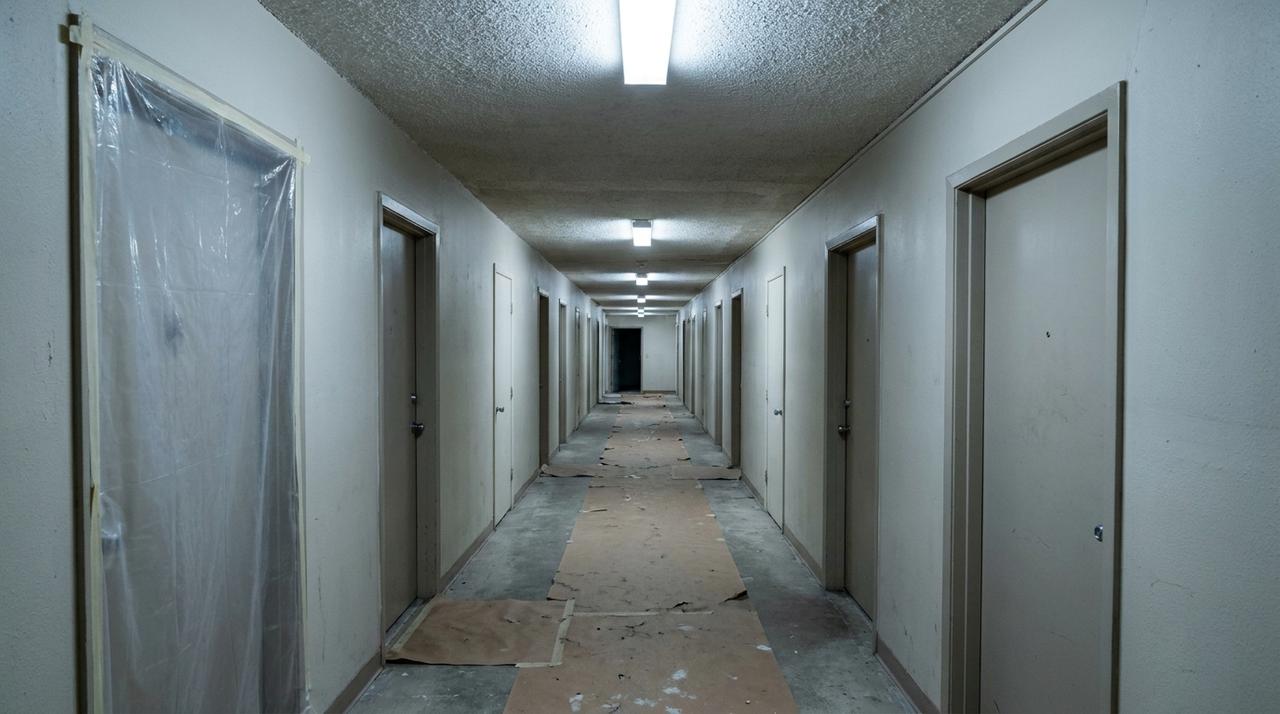
- Apartment and multi-family turnovers. The most common commercial ceiling request in the Golden Triangle. Unit-by-unit work between tenants, scheduled against a turnover calendar.
- Offices and professional suites. Usually after hours or across a weekend, with the work area sealed from occupied space.
- Clinics and medical offices. Containment standards are higher and scheduling is tighter; phasing matters more than speed.
- Schools and institutional buildings. Summer and break-period windows, with the documentation requirements that come with public buildings.
- Retail and hospitality. Refit-driven, often on a hard opening deadline.
Why Volume Changes the Price
Residential ceiling pricing is dominated by fixed costs — masking a room, protecting floors, setting up, cleaning down. Those costs barely shrink for a small job, which is why a single bedroom prices badly per square foot. On a forty-unit apartment turnover the same setup discipline is spread across far more area, and the per-square-foot number drops accordingly.
That is also why commercial ceiling work is worth scoping properly rather than piecemeal. A building owner taking popcorn out of units one at a time over two years pays substantially more than one running it as a programme.